
Eunseo Choi
Professor in Geophysics
Center for Earthquake Research and Information
The University of Memphis
Biography
Eunseo Choi is an associate professor of computational geodynamics at Center for Earthquake Research and Information (CERI) of The University of Memphis, Memphis, Tennessee, US. His research interests include long-term deformations in continental and oceanic lithosphere, seismotectonics, coupling of tectonic and surface processes and high-performance computing. He leads CERI’s Geodynamics Research Group collaborating with colleagues in seismology and geology.
Download my resumé .
Prospective students and post-docs, please visit the online CERI brochure.
- Long-term deformations in continental and oceanic lithosphere
- Seismotectonics
- Coupling of tectonic and surface processes
- High-performance computing, GPU computing
PhD in Geophysics, 2009
California Institute of Technology
BSc in Geology, 1998
Seoul National University
Experience
News
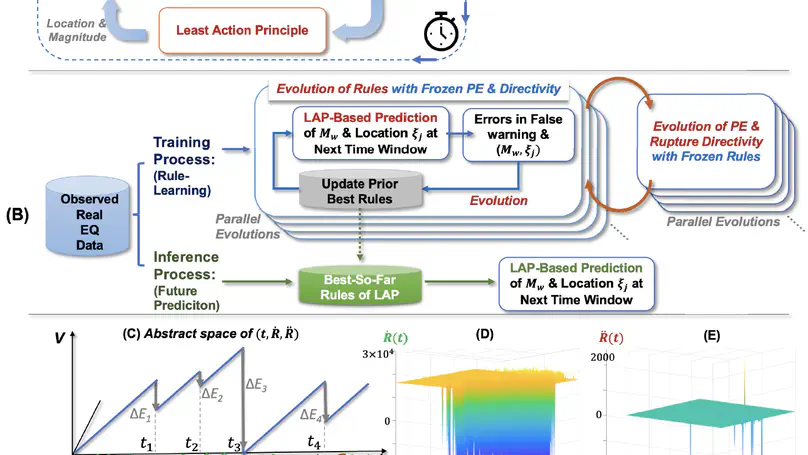
Understanding large earthquakes (EQs) has been a critical endeavor. Recent advancements in machine learning (ML) help this endeavor, yet they face formidable performance ceilings due to our technical limitations, restricted access to seismogenic fault zones, and the lack of large datasets for ML training. This paper introduces a novel approach by conceptualizing the EQ-bearing lithosphere as a chaotic system and investigating whether the least action principle (LAP) from Hamiltonian mechanics can illuminate the potential predictability of large EQ initiation. Leveraging an abstract space defined by time and rupture derivatives, this paper establishes a potential causal pathway between novel LAP-based features and large EQs. An evolving ML framework utilizing parallel evolution strategies was developed to identify hidden rules derived from LAP. The model was trained on data from all EQs in the western U.S. over the past 40 years. Feasibility tests on historical large EQs show promising performance compared to state-of-the-art forecasting methods. While practical applicability requires deeper investigation, these findings suggest a new research direction for large EQ prediction that merges classical physics and evolving ML.
Contact
- echoi2@memphis.edu
- +1 901 678 4923
- 3890 Central Ave, Memphis, TN 38152
- Enter House 3 and find Office 106 on Floor 1